The Berlin Ruling: Transparency or Surveillance? German Court Orders X to Surrender Data on Hungarian Election

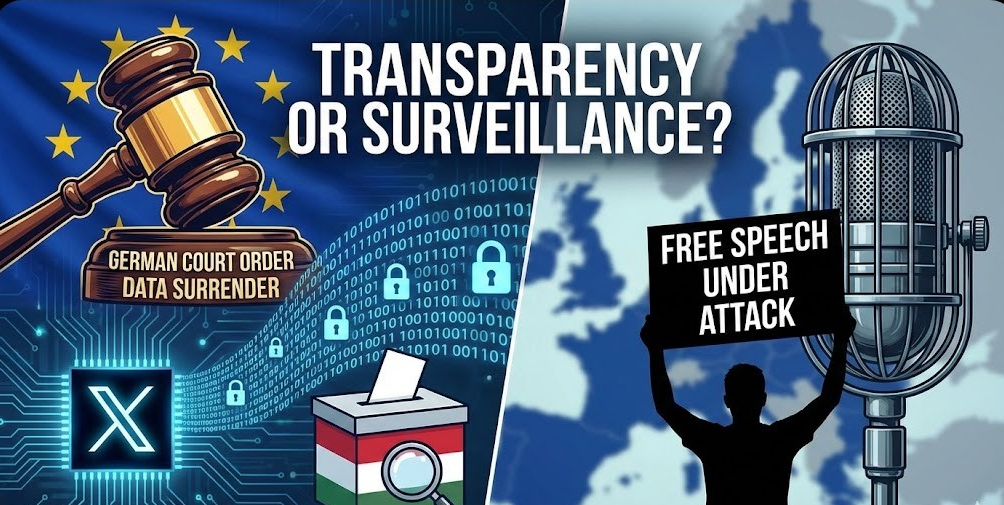
BERLIN — In a landmark decision that escalates the conflict between European regulators and Silicon Valley, the Berlin Court of Appeal has ordered social media platform X (formerly Twitter) to hand over internal engagement data related to the upcoming Hungarian parliamentary elections.
The ruling, delivered on Tuesday, compels X to provide researchers from Democracy Reporting International (DRI) and the Society for Civil Rights (GFF) with access to data detailing the reach, shares, and virality of political posts. While the court and European officials frame this as a necessary step to protect democratic integrity, critics—including free speech advocates—argue it represents a dangerous slippery slope toward state-sanctioned surveillance of political discourse.
 My Privacy Blog
The Legal Hammer: A Deep Dive into DSA Article 40
The court’s decision is grounded in Article 40 of the Digital Services Act (DSA), a powerful provision that effectively strips "Very Large Online Platforms" (VLOPs) of the right to keep their internal data private.
While the DSA is often discussed in broad terms, Article 40 is the specific mechanism that enforces transparency. It is divided into two key powers:
- Article 40(12) – Public Data Scrutiny: This was the specific clause invoked in the Berlin case. It mandates that platforms must provide researchers with access to "publicly available data" in real-time. Crucially, this goes beyond just seeing what is on the timeline; it requires platforms to hand over the metadata that explains why a post is successful.
- Article 40(4) – The "Black Box" Access: For vetted researchers, this provision goes even further, allowing access to non-public data to assess "systemic risks."
What specific data points are researchers requesting?
In the context of the Hungarian election, the researchers are not just asking for a list of tweets. They are demanding granular metrics that reveal the mechanics of virality, including:
- Impression Counts: The exact number of times a post was viewed, which is often far higher than engagement numbers suggest.
- Share Propagation: Data showing the "chain of custody" for a viral post—who shared it first, and how quickly it traveled through specific networks.
- Demographic Targeting: Information on which specific groups of users (broken down by age, location, or interests) are seeing specific political narratives.
- Moderation Logs: Details on whether X’s algorithms flagged specific posts for review and what actions (if any) were taken.
For privacy advocates, this level of access is alarming. It grants third-party researchers—often funded by NGOs or state grants—a "god mode" view of public discourse, allowing them to map out political dissent with terrifying precision.
 Compliance Hub
Elon Musk vs. The EU: A History of "Bullst" and Defiance**
This ruling is merely the latest skirmish in a long-running war between Elon Musk and the European Union. Since acquiring Twitter, Musk has positioned X as a bulwark of free speech, putting him on a collision course with Brussels.
Musk’s response to previous DSA mandates has been combative, public, and explicit.
- The "Secret Deal" Allegation: In July 2024, Musk publicly claimed that the European Commission offered X a "secret illegal deal." He alleged that the EU promised to waive fines if X agreed to "quietly censor speech" without telling its users. "The other platforms accepted that deal. X did not," Musk wrote, framing his refusal as a moral stand against backdoor censorship.
- "Bullst" Fines:** When the EU threatened fines for failing to comply with transparency rules, Musk simply tweeted the word "Bulls**t" in response to an official Commission post. He has repeatedly characterized the DSA not as a safety law, but as a mechanism for bureaucratic control over the internet.
- Withdrawal from the Code of Practice: One of Musk’s first moves was to pull Twitter out of the EU’s voluntary "Code of Practice on Disinformation," signaling early on that he viewed the bloc’s definition of "disinformation" as politically motivated.
For Musk, the Berlin ruling is likely to be seen as a validation of his warnings: that "transparency" laws would eventually be used to force platforms to surrender data on political opposition.
"An Attack on Free Speech": The Opposition
While the EU celebrates the ruling as a victory for accountability, the opposition views it as a "Trojan Horse" for censorship.
The core argument is that "assessing risk" is a euphemism for preparing to silence. Critics argue that by forcing platforms to hand over granular data on how information spreads, governments are building the infrastructure to police narratives they find objectionable.
"This is not about 'data'; it is about monitoring and ultimately controlling the flow of information," argues one digital rights commentator. "When you force a private platform to open its books to state-approved researchers for the specific purpose of finding 'interference,' you create a chilling effect. Platforms will inevitably over-censor content to avoid regulatory headaches."
 Compliance Hub
The Hungarian Context
The focus on Hungary adds a layer of geopolitical friction. Hungary’s Prime Minister Viktor Orbán is frequently at odds with EU leadership. By ordering data scrutiny specifically for this election, skeptics see the EU utilizing its regulatory power to keep tabs on a member state’s internal politics.
Conversely, the plaintiffs argue that Hungary’s media landscape is already centralized and that X remains one of the few spaces for opposition voices. They contend that without this data, it is impossible to know if the election is being manipulated by bot networks or opaque algorithmic suppression.
As the April 12 election approaches, the data X is now forced to reveal will likely become the next battleground. For the EU, it is a triumph of regulation. For free speech absolutists, it is a warning that the digital public square is no longer private.
 Compliance Hub